OpenAI Retracts Pro 200 Downgrade & Grants API Credits: From Cost-per-Task and Prompt Caching to Tokenizer Variance, A Deep Dive into AI Subscriptions & Token Economics
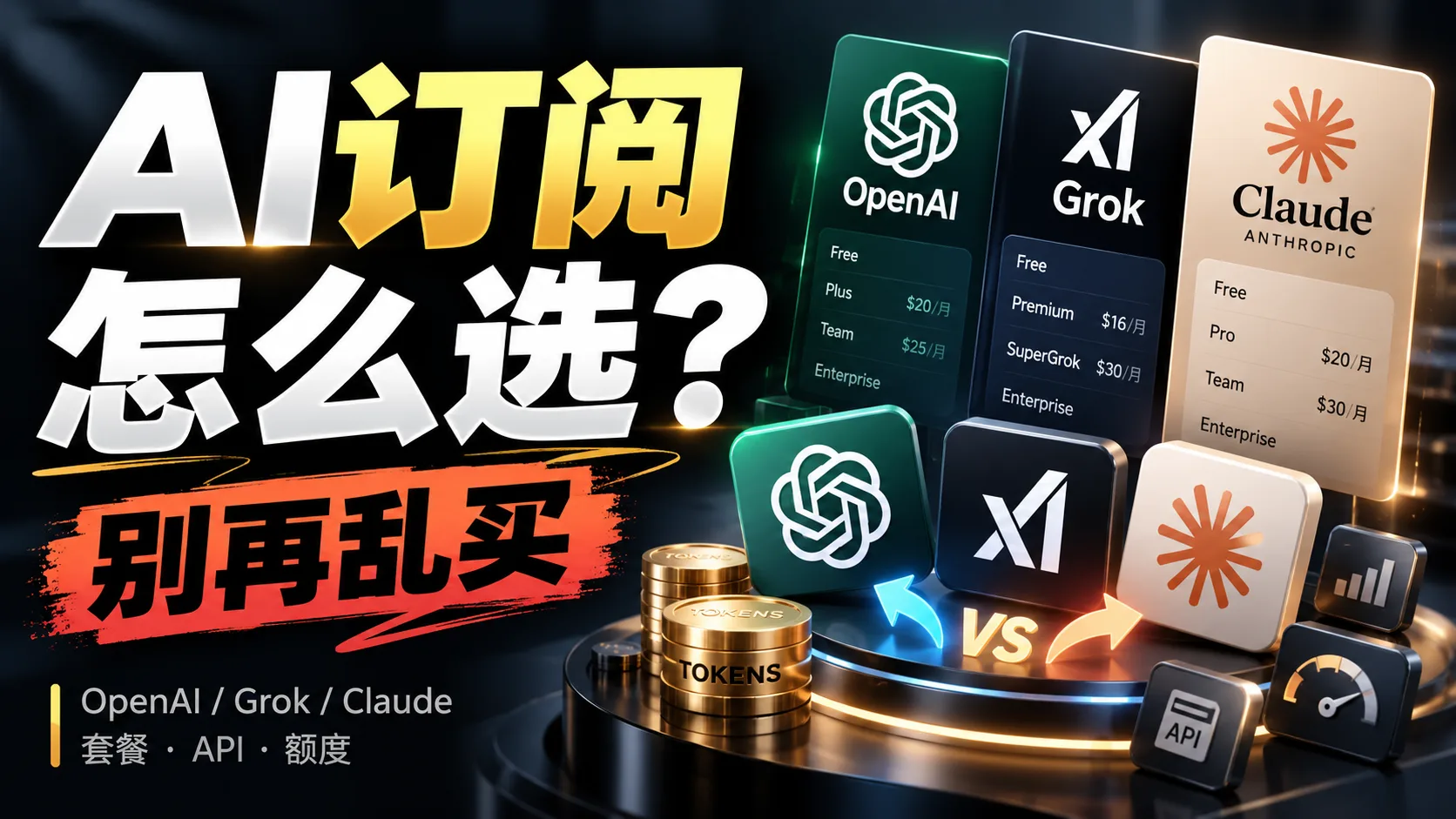
全景拆解 OpenAI 撤回 Pro 200 降配计划、Work/Codex 配额翻倍及最高 500 美元 API Credits 补偿背后的商业逻辑与工程核算。对比 X Subscription(Grok/Cursor/Premium 捆绑)的配额稀释机制;用短上下文与纯 API 测算 20 美元订阅与按量计费的 ROI 分水岭;剖析 Agent 重复 System Prompt 成本陷阱、Prompt 缓存写入/读取经济学、GPT-6.1 超长上下文两倍计费阶梯、新旧 Tokenizer 30% 密度差异;提出以“每成功交付任务成本”为核心的轻量模型路由与防供应商锁定策略。
A comprehensive teardown of OpenAI's reversal on Pro 200 downgrade plans, doubling Work/Codex allowances and issuing up to $500 monthly API credits. We contrast X Subscription's unified bundling (Grok, Cursor, X Premium) and quota dilution dynamics; benchmark $20 product subscriptions against metered API economics; expose agent cost pitfalls from repetitive system prompts; analyze prompt caching ROI (5-min vs 1-hour), GPT-6.1 stepped long-context billing (>272K tokens), and cross-model tokenizer density shifts (~30%). Finally, we formulate a lightweight model routing framework centered on 'Cost per Successful Task' with vendor-agnostic portable engineering practices.
大家好 我是为什么叫QQ
Hello everyone, I'm WhyQQ.
10月29日 OpenAI撤回了Pro 200的减配方案
On October 29, OpenAI rolled back its Pro 200 tier downgrade plan.
已经保有高额度的人 额度不动
Users who already held high quotas keep their allocations unchanged.
处在低额度的人 Work和Codex额度翻倍 追平前者
Those on lower quotas saw their Work and Codex allowances doubled, matching the higher tier.
Pro 100和Pro 500也拿到两倍Work和Codex额度
Pro 100 and Pro 500 users also received doubled Work and Codex allowances.
Plus没有参与这次调整
The Plus tier was not part of this adjustment.
很多人看到“翻倍”
When many see the headline "doubled",
会默认所有模型 所有功能都翻倍
they assume every model and every feature doubled.
官方特意把范围限定在Work和Codex
However, OpenAI specifically restricted the scope to Work and Codex.
GPT-6 Pro在Chat里的消息限制另算
Message limits for GPT-6 Pro in standard Chat are calculated separately.
这个细节很程序员:
This detail is quintessential engineering discipline:
看变更先看作用域 别只看标题里的数字
When evaluating changes, check the scope first—never just the numbers in the title.
前一天 OpenAI还上线了另一项权益
The day before, OpenAI rolled out another major entitlement:
符合条件的Pro 100 200 500用户
Eligible Pro 100, 200, and 500 subscribers
每个计费周期可领取100
can claim $100,
200, 500美元API Credits
$200, or $500 in API credits each billing cycle.
Business Standard每个付费席位20美元
Business Standard receives $20 per paid seat,
Premium 100美元 工作区每月封顶500美元
Premium gets $100 per seat, capped at $500 per workspace monthly.
Plus不在名单里
Plus is not included on this roster.
你还要主动激活
You must also actively claim it:
关联自己拥有的API Organization
link an API Organization that you own,
订阅至少已付费7天
with a subscription paid for at least 7 days.
额度在计费周期结束时过期
The credits expire at the end of each billing cycle,
不结转 也不提高Chat GPT
without roll-over, nor do they raise limits on ChatGPT
或登录版Codex的使用上限
or web-based Codex.
通过API Key运行Codex 同样不能用这笔Credits
Running Codex via API Key also cannot consume these credits.
它更像开发预算 少了“订阅回本”这种简单算法
It functions more like a development allowance rather than a simple "recouping subscription" perk.
看到这里你可能会想
Seeing this, you might wonder:
订阅和API的边界是不是正在消失
Is the boundary between subscriptions and APIs disappearing?
我反而建议把账单分成两层
On the contrary, I recommend splitting your bill into two distinct layers.
产品订阅买的是工作环境:
Product subscriptions pay for the complete workspace:
界面 文件 记忆 Agent 工具集成
UI, file handling, persistent memory, agent runtime, and tool integrations,
还有一套使用规则
along with a set of fair-use policies.
API主要买模型推理 以及你实际调用的工具
APIs primarily purchase raw model inference and specific tool executions.
ChatGPT Plus里的Deep Research
Features like Deep Research in ChatGPT Plus,
语音和文件分析
voice mode, and document analysis
不会因为你有20美元API余额就自动出现
won't magically appear just because you have a $20 API balance.
Cursor的补全 代码库索引和云端Agent
Cursor's tab autocomplete, codebase indexing, and cloud agents
也不会随一个模型Key一起打包送来
also don't arrive bundled with a raw model key.
先确认自己每天用的是哪一层
First identify which layer you truly rely on day to day;
再谈替换 能省掉很多无效迁移
then evaluate replacements to avoid wasteful migrations.
10月12日 另一边的X Subscription把Grok
On October 12, X Subscription bundled Grok,
Grok Bot Cursor和X Premium放进同一个套餐
Grok Bot, Cursor, and X Premium into a unified package.
新价格从免费 8美元Plus 到30美元Premium
New tiers span from Free and $8 Plus to $30 Premium,
100美元Super 200美元Ultra
up to $100 Super and $200 Ultra.
官方给Premium的对照是 过去分别购买SuperGrok
The official comparison for Premium claims that separately purchasing SuperGrok,
Cursor Pro和X Premium+合计90美元
Cursor Pro, and X Premium+ previously totaled $90.
这个对比很吸引人 但新旧额度并不完全等价
The contrast is compelling, but the quota models are not directly equivalent.
老用户也能暂时保留原套餐
Legacy users can temporarily retain their existing plans as well.
别急着按90减30得出结论
Don't jump to conclusions simply by subtracting $30 from $90.
对开发者来说 真正改变账单的是计费边界:
For developers, what genuinely shifts your bill is the accounting boundary:
同一笔钱覆盖更多入口
The same dollar covers more entry points,
每个入口消耗的额度却开始互相影响
yet consumption across different surfaces now impacts the same quota pool.
新套餐里 Grok和Cursor共享
In the new plan, Grok and Cursor share
一份每周刷新的Grok模型额度
a single weekly-refreshed Grok model allocation.
你在Grok应用里聊天 生成内容
Chatting or generating content in the Grok app
或者在Cursor里跑Agent 都可能动到同一个池子
or running coding agents inside Cursor draws down from the exact same pool.
Premium及以上仍可选Claude GPT等第三方模型
Premium and higher still offer third-party models like Claude and GPT,
但从第一次调用起 就按API标价用预付余额另付
but from the very first call, they bill against prepaid balances at raw API list prices.
旧Cursor套餐里的第三方模型额度
The third-party model quota included in legacy Cursor plans
只有在你没切换时继续保留
is only preserved if you remain on the grandfathered tier.
很多人会觉得 打包等于批发价
Many believe bundling equates to wholesale discounts.
对主要使用Grok的人 这可能成立
For heavy Grok users, that may hold true.
对天天在Cursor里跑Claude的人
For developers driving Claude inside Cursor daily,
30美元月费只买到一部分工作流 模型账还在后面
the $30 monthly fee covers only partial workflows; the model bill follows.
你更看重套餐总价 还是模型自由?
Do you prioritize all-in-one bundle pricing, or model freedom?
把选择打在公屏上
Share your preference in the chat!
把视线移到纯API 数字会很直观
Turning to raw APIs, the economics become immediately transparent.
按短上下文标准文本价格
Under standard short-context text pricing,
假设一个月消耗500万输入
assume a monthly volume of 5 million input tokens
Token和100万输出Token
and 1 million output tokens.
GPT-6.1 Sol是20美元 Terra是10美元
GPT-6.1 Sol costs $20, Terra is $10,
Luna是1美元 Claude Sonnet 5.5是20美元
Luna costs $1, Claude Sonnet 5.5 is $20,
Grok 4.7是16美元
and Grok 4.7 comes in at $16.
计算过程就是输入量乘输入单价
The math is straightforward: input volume times input price,
再加输出量乘输出单价
plus output volume times output price.
这里没有缓存 工具 长上下文加价
This excludes prompt caching, tool calls, and long-context surcharges,
也没有考虑任务成功率
nor does it factor in task success rates.
所以它适合当费率示例 不适合当采购结论
Thus, it serves as a baseline rate example, not a procurement verdict.
Luna只要1美元 依然不能自动替代20美元订阅
Even at $1, Luna cannot automatically substitute for a $20 product subscription.
差别就在下一个变量:
The disparity lies in the next critical variable:
同样Token 未必完成同样工作
Equal tokens do not necessarily deliver equal work.
20美元API额度 不能直接替代20美元产品订阅
A $20 API allocation cannot directly replace a $20 product subscription.
对偶尔调用模型 已有自己脚本和工作流的人
For those with established scripts and occasional invocation,
按量付费很好控制
pay-as-you-go provides tight cost control.
对每天依赖文件解析
For engineers relying every day on document parsing,
语音 代码补全和云端Agent的人
voice transcription, code completion, and cloud agents,
订阅里的产品功能可能更省时间
the turnkey capabilities in subscriptions save far more billable time.
程序员还要算迁移成本:
Developers must also calculate engineering migration overhead:
鉴权 日志 重试 限流 评测 数据权限
auth, observability, retries, rate-limiting, evals, and ACLs
都得有人维护
all require maintenance.
很多人比较价格时 只复制了模型请求
Many price comparisons merely clone model request costs,
漏掉了原来由产品承担的工程劳动
neglecting the underlying engineering labor previously handled by the product.
我的建议是 高频工作台保留订阅
My recommendation: keep subscriptions for high-frequency workbenches,
零散任务走API 两边都记录真实用量
route ad-hoc tasks via APIs, and log true consumption across both.
别凭感觉站队
Avoid dogmatic stances based on intuition alone.
Agent账单最容易失控的地方 是重复上下文
The fastest way agent bills spiral out of control is redundant context.
一次请求里可能塞着System Prompt
A single prompt may bundle system instructions,
项目规范 工具定义 历史
repo guidelines, tool schemas, conversation history,
消息 代码片段和终端输出
messages, code snippets, and terminal logs.
下一步请求来了 这些内容又原样走一遍
When the next step triggers, that entire payload re-traverses the wire.
你关注的是模型多写了几行代码
You focus on the few new lines of code emitted;
计费系统看到的是整段输入重新进入
the billing engine sees the full input block re-entering the pipeline.
连续跑50次 重复部分会盖过真正新增的问题
Across 50 iterations, boilerplate repetition dwarfs the actual delta.
处理办法也很工程化:
The remedy is deeply architectural:
稳定内容放前面 过期工具输出及时清理
order stable content first, purge stale tool outputs proactively,
长对话做摘要 检索只返回相关代码
summarize long sessions, and restrict retrieval to pinpointed snippets.
先看请求日志 再谈换便宜模型
Inspect your request telemetry before rushing to switch to cheaper models;
通常更快找到浪费
that is where true waste is uncovered fastest.
缓存能把稳定前缀的成本压下来
Prompt caching dramatically drives down the cost of stable prefixes.
以Claude Sonnet 5.5为例
Taking Claude Sonnet 5.5 as an example:
普通输入每百万Token 2美元
Standard input is $2 per million tokens;
5分钟缓存写入2.5美元 1小时写入4美元
a 5-minute cache write is $2.50, and a 1-hour write is $4.00.
缓存读取0.1美元 写入更贵 所以复用才有收益
Cache reads cost only $0.10. Writes are pricier, meaning ROI requires reuse.
5分钟方案命中一次后
Under the 5-minute cache scheme, a single cache hit
总花费已经低于两次完整输入;
already drops total spend below two raw un-cached requests;
1小时方案需要更多复用
the 1-hour tier demands higher query frequencies.
离线任务还有Batch API
For asynchronous workloads, the Batch API offers
符合条件的输入和输出都打五折
a 50% discount on both eligible input and output tokens.
适合批量评测 分类和文档提取
It is tailor-made for bulk evaluations, classification, and batch extraction.
交互式Coding Agent等不了异步队列 就别硬套
Interactive coding agents cannot tolerate async queues—never force that fit.
便宜来自访问模式 折扣本身不会优化架构
Savings stem from access patterns; raw discounts alone won't fix flawed architecture.
长上下文也有不同的计费规则
Long contexts also carry distinct billing models.
OpenAI的GPT- 6.1系列在单次
OpenAI's GPT-6.1 family dictates that when a single
请求超过272K输入Token后
request exceeds 272K input tokens,
整次请求的输入和缓存输入按两倍计
input and cached-input tokens across the entire request bill at 2x,
输出按1.5倍计
while output tokens bill at 1.5x.
Grok 4.7到达200K输入Token后
For Grok 4.7, once input hits 200K tokens,
整次请求进入更高费率
the full request scales into a higher pricing tier.
这里说的是单次请求 不是月度累计
Notice this applies per individual request, not cumulative monthly volume.
Claude 4.6及后续模型大多在
Most Claude 4.6 and subsequent models retain
100万Token上下文内维持标准单价
standard flat rates up to a 1-million-token context window,
Haiku 5.5另有分档
with tiered exceptions in Haiku 5.5.
上下文窗口是容量上限 不是使用目标
A context window is an upper capacity limit, not an aspirational goal.
把仓库整个塞进去之前
Before dumping an entire codebase into context,
先做检索 摘要和依赖裁剪
run lexical search, summarization, and dependency pruning.
账单和注意力都会更轻松
Both your budget and the model's attention will thank you.
跨供应商比较Token 还有一个坑:分词器不同
Comparing tokens across vendors hides another trap: tokenizer variance.
Anthropic说明
Anthropic documentation notes that
Claude 4.7及后续模型使用新Tokenizer
Claude 4.7 and later adopt a redesigned tokenizer.
同一段文本产生的Token数可能比旧版多约30%
The exact same source text can yield roughly 30% more tokens than prior versions,
具体取决于内容
depending on the underlying content.
中文 代码 日志和JSON的结果也不会一致
Chinese prose, code, logs, and JSON tokenize with widely divergent efficiencies.
每百万Token的单价看起来统一
A standardized price per million tokens appears uniform,
背后的工作量单位却不完全统一
yet the underlying unit of semantic work is fundamentally inconsistent.
要做采购测试 就准备同一批真实任务
To conduct rigorous procurement benchmarks, curate an identical set of real-world tasks:
固定输入文件 工具权限和验收标准
fix input files, tool permissions, and acceptance criteria,
记录每家实际消耗的输入 输出 缓存与工具调用
and log actual inputs, outputs, cache hits, and tool calls for each vendor.
只拿价格表做横向排名
Ranking providers purely by list prices
很像只按函数行数评估两个实现
is as misleading as evaluating two algorithms solely by their line counts.
我更喜欢一个指标:每个成功任务的成本
I favor a more actionable metric: Cost per Successful Task.
分子放模型费 工具费
In the numerator, tally model fees, tool execution costs,
再加上人工审核和修复时间
plus human review and remediation time;
分母放通过验收的任务数
in the denominator, divide by tasks passing verification.
一个便宜模型如果反复改错测试 漏掉边界条件
If a cheaper model continually breaks tests and misses edge cases,
你还要回到终端修半小时
forcing you into 30 minutes of terminal debugging,
它省下的Token费很快就被吞掉
any token savings are instantly incinerated by human labor.
贵模型也不自动划算
Nor are expensive models automatically cost-effective:
简单分类和格式转换用不上那么强
trivial classification and formatting do not require flagship reasoning.
给任务设定明确验收条件
Establish crisp acceptance criteria for each workflow:
比如测试通过 Schema合法 人工无需返工
passing test suites, valid schema output, and zero manual rework.
没有“成功”的定义
Without a clear definition of success,
成本优化很容易变成把失败生产得更快
cost optimization merely manufactures failures faster.
这个成本口径你认不认?把看法打在公屏上
Does this cost framework resonate with you? Sound off in the comments!
落地时 可以做一个轻量路由
In production, deploy a lightweight model router:
分类 提取 格式转换先走低价模型
route classification, extraction, and formatting to economy models;
常规代码修改和总结交给中档模型
delegate routine refactoring and summaries to mid-tier models;
复杂调试 架构决策再上调到前沿模型
and escalate tricky debugging or architecture decisions to frontier flagships.
路由规则别只写任务名称 还要写升级条件:
Never base routing rules purely on task names; define explicit escalation gates:
测试连续失败 上下文超过预算 工具调用异常
consecutive test failures, context overruns, or anomalous tool calls
就切换或停止
should trigger automatic escalation or termination.
选30到50个你仓库里的真实任务
Curate 30 to 50 genuine tasks from your own codebase;
每周跑一遍 记录成功率 延迟 重试和审核分钟数
run them weekly, logging pass rates, latency, retries, and review minutes.
这个小评测集比模型榜单更接近你的工作环境
This focused eval benchmark mirrors your reality far better than public leaderboards,
也能直接告诉你哪档模型该留在默认路由里
directly signaling which tier belongs in your default routing path.
月底复盘时也有依据
It gives you concrete telemetry during monthly budget retrospectives.
订阅权益还会受产品合作影响
Subscription value is also subject to ecosystem partnership volatility.
OpenAI计划结束直接向Cursor提供模型的合同
OpenAI plans to sunset its contract directly supplying models to Cursor,
提出的过渡日期是11月12日
proposing a transition target of November 12,
双方尚未确认最终终止日
though neither side has confirmed a definitive termination date.
自己的OpenAI API Key只覆盖Cursor
Bringing your own OpenAI API key into Cursor only covers
桌面版里受支持的本地Chat和Agent 不覆盖Tab
supported local chat and agent workflows in desktop—not Tab autocomplete,
Auto 云端或后台Agent Automations
Cursor Auto, cloud agents, or background automations.
CLI API和SDK Codex IDE扩展也是独立Agent体验
CLIs, SDKs, and native Codex IDE extensions represent decoupled agent runtimes.
对团队的提醒很具体:
The practical takeaway for engineering teams is stark:
把关键工作流依赖写成清单
maintain a clear inventory of critical workflow dependencies,
至少保留一条可迁移路径
and ensure at least one viable migration fallback.
模型能换 仓库上下文 权限
While models can be swapped, your repository context, permissions,
评测和审计记录也要跟着搬走
eval benchmarks, and audit histories must stay portable.
这几项变化放在一起 AI收费正在变成订阅
Taken together, AI pricing is evolving into a hybrid matrix:
共享额度和按量计费的组合
subscriptions, shared quota pools, and pay-as-you-go metered billing.
程序员没必要预测下一次套餐改名
Developers don't need to predict every pricing rebrand.
先把可观测性补上:
Focus on closing your observability gap first:
知道每个任务调了谁 花了多少 失败了几次
know which provider handled each task, what it cost, and how often it failed.
给自己做一次30天审计 列出每个订阅的使用频率
Conduct a 30-day tooling audit: catalogue usage frequency for each subscription,
独有功能 重叠额度和迁移成本
unique capabilities, overlapping allowances, and switching friction,
再决定保留或替换
before deciding whether to retain or consolidate.
每天创造价值的工作台值得付费
Workspaces that create daily leverage are well worth paying for;
偶尔需要的模型可以按量调用
infrequently needed models should be called on-demand via API.
你现在是按订阅数量配工具
Are you budgeting tools by seat count,
还是按任务成功率配模型?
or sizing models by verified task ROI?
欢迎把账单口径贴在评论区
Share your team's billing breakdown in the comments.
我是为什么叫QQ 感谢观看 别忘了一键三连
I'm WhyQQ. Thanks for watching—don't forget to like, subscribe, and share!
大家好 我是为什么叫QQ
Hello everyone, I'm WhyQQ.
全景拆解 OpenAI 撤回 Pro 200 降配计划、Work/Codex 配额翻倍及最高 500 美元 API Credits 补偿背后的商业逻辑与工程核算。对比 X Subscription(Grok/Cursor/Premium 捆绑)的配额稀释机制;用短上下文与纯 API 测算 20 美元订阅与按量计费的 ROI 分水岭;剖析 Agent 重复 System Prompt 成本陷阱、Prompt 缓存写入/读取经济学、GPT-6.1 超长上下文两倍计费阶梯、新旧 Tokenizer 30% 密度差异;提出以“每成功交付任务成本”为核心的轻量模型路由与防供应商锁定策略。